
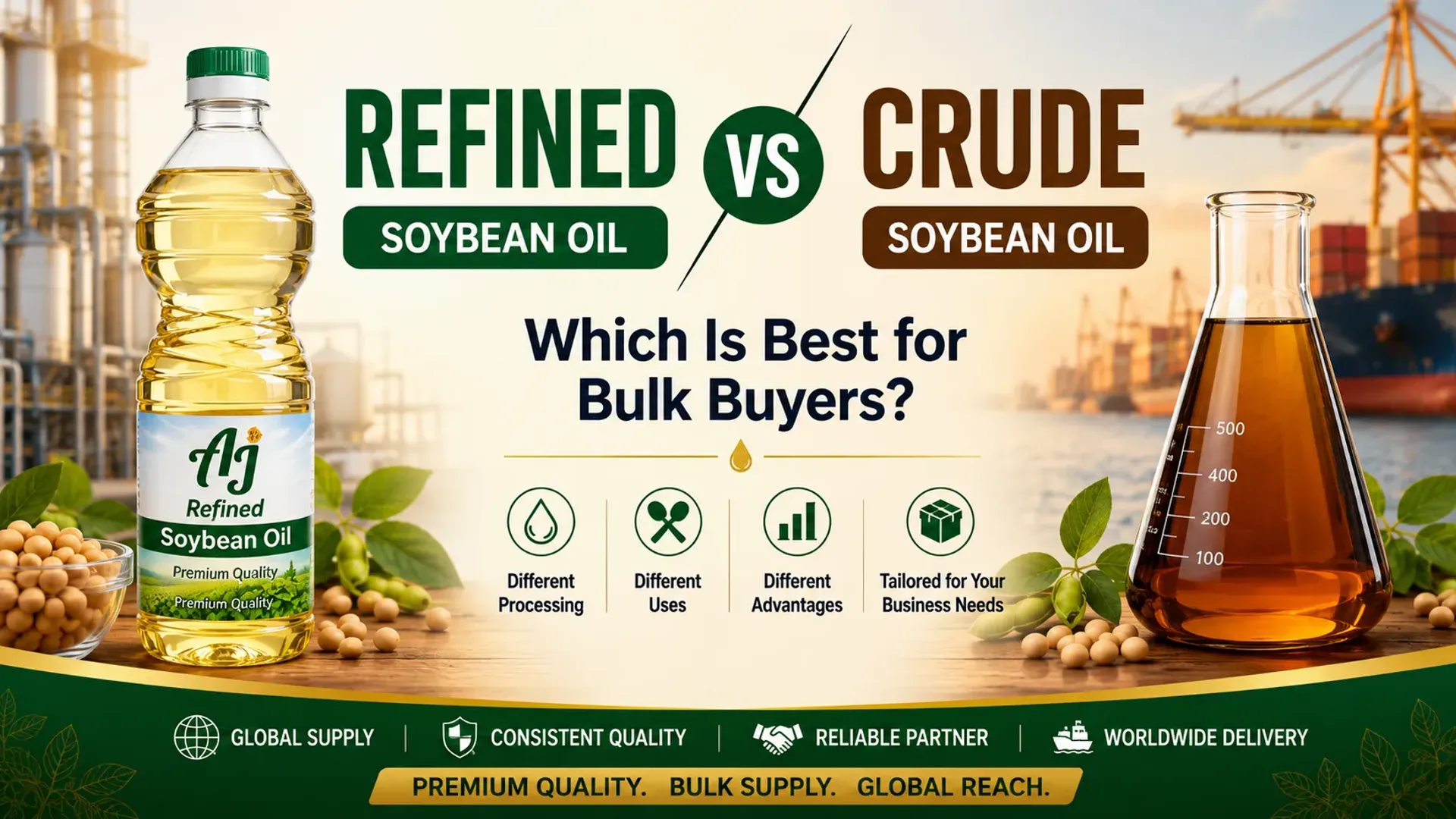
For bulk buyers, the main difference between refined soybean oil and crude soybean oil is processing and intended use. Refined soybean oil is generally selected for food manufacturing, commercial cooking, frying, foodservice, and retail applications, while crude soybean oil is primarily purchased for further refining or industrial processing.
France AJ Group supplies refined and crude soybean oil for B2B wholesale, bulk purchasing, and international export. This guide explains the key differences to help importers, distributors, refineries, food manufacturers, and commodity buyers select the appropriate soybean oil for their requirements.
Explore our bulk edible oils: Bulk Cooking Oil Wholesale & Export for refined and crude vegetable oils available for international B2B supply.
What Is Refined Soybean Oil?
Refined soybean oil is soybean oil that has undergone refining processes designed to remove undesirable impurities, free fatty acids, pigments, flavours, odours, and other unwanted components.
Depending on the production process and required specification, refining may include degumming, neutralization, bleaching, deodorization, and other processing stages.
The finished product is generally lighter in colour, neutral in flavour, and suitable for a wide range of commercial food applications. It is commonly purchased by food manufacturers, wholesalers, restaurants, commercial kitchens, foodservice distributors, catering companies, and retail cooking oil businesses.
Typical applications include deep frying, commercial cooking, bakery products, sauces, mayonnaise, dressings, margarine, prepared foods, snacks, and packaged edible cooking oil.

B2B Wholesale & International Export
Refined Soybean Oil – 1L Bottles
Refined soybean cooking oil supplied in 1L bottles for importers, distributors, foodservice operators, commercial kitchens, wholesalers, and international buyers.
What Is Crude Soybean Oil?
Crude soybean oil is obtained after oil extraction and before complete refining. Because the oil has not undergone the full refining process, it can still contain phospholipids, free fatty acids, natural pigments, moisture, trace impurities, and other naturally occurring soybean components.
Crude soybean oil is mainly purchased by edible oil refineries, industrial processors, biodiesel producers, animal feed manufacturers, commodity traders, and companies with their own refining capabilities.
Buyers may also encounter crude degummed soybean oil (CDSO), where a degumming process has removed a significant portion of phospholipids or gums before the oil enters additional refining stages.

Bulk Industrial Supply
Crude Soybean Oil
Bulk crude soybean oil for refineries, industrial processors, biodiesel manufacturers, commodity traders, feed producers, and international buyers requiring soybean oil for further processing.
Refined vs Crude Soybean Oil: Key Differences
The main difference between refined and crude soybean oil is the level of processing. Refined soybean oil has undergone additional treatment to meet the requirements of finished commercial or food applications, while crude soybean oil is generally an intermediate raw material that requires further processing.
Factor | Refined Soybean Oil | Crude Soybean Oil |
|---|---|---|
Processing | Fully refined | Unrefined or partially processed |
Typical Use | Food manufacturing, frying, cooking and foodservice | Further refining and industrial processing |
Colour | Generally lighter | Generally darker |
Flavour & Odour | Typically neutral after refining | More characteristic of crude oil |
Main Buyers | Food manufacturers, wholesalers, distributors and foodservice companies | Refineries, industrial processors and commodity traders |
Further Refining | Normally not required for intended finished use | Generally required |
Which Soybean Oil Is Better for Deep Frying?
For commercial deep frying and food preparation, refined soybean oil is generally the appropriate choice. Refining gives the oil characteristics that are better suited to cooking and food manufacturing than crude soybean oil.
Restaurants, catering companies, commercial kitchens, snack manufacturers, and industrial food processors searching for soybean oil for deep frying wholesale should therefore evaluate refined soybean oil specifications rather than crude soybean oil.
Buyers looking for foodservice and wholesale supply can view our Refined Soybean Oil – 1L Bottles.
Which Soybean Oil Is Better for Food Manufacturing?
Refined soybean oil is generally used for food manufacturing when a finished edible oil meeting the buyer's required specification is needed.
Applications may include frying oils, bakery products, sauces, salad dressings, mayonnaise, margarine, prepared foods, snacks, and other processed food products.
Food manufacturers purchasing bulk refined soybean oil should confirm the technical specification, packaging format, quantity, destination, required documents, and applicable food or import requirements before placing an order.
Who Should Buy Crude Soybean Oil?
Crude soybean oil is more appropriate for buyers that have the infrastructure to refine, process, or transform the oil after purchase.
Typical B2B buyers include edible oil refineries, biodiesel manufacturers, industrial processors, feed manufacturers, and commodity traders.
For these companies, purchasing crude soybean oil in bulk can provide flexibility over the final refining process and finished product specification.
Crude vs Crude Degummed Soybean Oil
Crude soybean oil and crude degummed soybean oil should not automatically be treated as identical products.
Degumming is a processing stage designed to remove phospholipids or gums from crude soybean oil before further refining.
International buyers should therefore clearly state whether they require standard crude soybean oil or crude degummed soybean oil (CDSO) when requesting a quotation.
What Specifications Should Bulk Soybean Oil Buyers Check?
Specifications can vary according to product grade, producer, origin, destination market, processing method, and contractual requirements.
Professional buyers should evaluate the actual product specification sheet and Certificate of Analysis rather than relying only on the product name.
Free Fatty Acids (FFA)
Peroxide Value
Moisture and Impurities
Colour
Iodine Value
Phosphorus, particularly for crude or degummed soybean oil
Odour and appearance
Other contractual quality parameters
The acceptable limits depend on the soybean oil grade, buyer requirements, intended application, and specifications agreed between buyer and seller.
How to Read a Soybean Oil Specification Sheet
A soybean oil specification sheet helps professional buyers determine whether the product meets their technical and commercial requirements.
Instead of comparing suppliers based only on price, buyers should review quality parameters together with product origin, processing method, packaging, quantity, inspection terms, shipping conditions, and documentation.
This is particularly important when comparing refined soybean oil suppliers or purchasing crude soybean oil for further refining.
Bulk Soybean Oil Packaging Options
The appropriate soybean oil packaging depends on order quantity, buyer requirements, transportation method, destination, unloading facilities, and product specification.
Commercial soybean oil shipments may use packaging formats such as:
Retail bottles
Drums
IBC containers
Flexitanks
Other suitable bulk liquid transportation systems
For large B2B orders, packaging and loading requirements should be confirmed before contract finalization because they can affect freight costs, handling, storage, unloading, and total landed cost.
Buyers can also explore additional products through our Bulk Cooking Oil Wholesale & Export category.
Soybean Oil Flexitank Shipping for Bulk Buyers
Soybean oil flexitank shipping can be considered for suitable bulk liquid shipments. A flexitank is installed inside a compatible shipping container and provides a method for transporting large quantities of liquid commodities.
Importers considering this option should verify product compatibility, carrier requirements, loading quantity, container suitability, insurance, destination procedures, unloading capabilities, and applicable food transportation requirements.
What Documents Should Soybean Oil Importers Request?
Documentation requirements depend on product origin, destination country, contractual terms, buyer requirements, and applicable regulations.
Depending on the transaction, buyers may request documents such as:
Commercial Invoice
Packing List
Bill of Lading
Certificate of Origin
Certificate of Analysis (COA)
Product Specification Sheet
Health or sanitary documentation where applicable
Inspection documentation when contractually required
Importers should verify current destination-country import and regulatory requirements before shipment.
Refined vs Crude Soybean Oil: Which Should Bulk Buyers Choose?
Choose refined soybean oil when your business requires soybean oil for commercial cooking, deep frying, food manufacturing, foodservice, distribution, retail packing, or other finished edible-oil applications.
Choose crude soybean oil when your company has refining or processing capabilities and requires soybean oil as a raw material for further processing.
For refinery buyers, it is also important to determine whether the requirement is for standard crude soybean oil or crude degummed soybean oil.
How to Choose a Bulk Soybean Oil Supplier
Price should not be the only factor when choosing a bulk soybean oil supplier.
International buyers should also evaluate:
Product specification
Product origin
Supply capability
Minimum order quantity
Packaging options
Inspection requirements
Documentation
Shipping terms
Destination port
Commercial conditions
A professional soybean oil request for quotation should clearly state the required product, quantity, destination port, preferred Incoterm, packaging format, technical specification, required documents, and any inspection requirements.
Bulk Refined and Crude Soybean Oil for International Export
France AJ Group supplies refined soybean oil and crude soybean oil for B2B wholesale and international export.
Our soybean oil supply solutions are intended for importers, distributors, food manufacturers, refineries, industrial processors, wholesalers, and commodity buyers seeking commercial quantities for international markets.
Buyers can request information about available specifications, product origins, packaging options, minimum order quantities, shipping terms, and current commercial offers.
Request a Bulk Soybean Oil Quotation
Send your required soybean oil type, quantity, destination port, packaging preference, technical specification, and preferred shipping terms. Our team can provide information about available commercial supply options.
Refined Soybean Oil Crude Soybean Oil View All Oils
Frequently Asked Questions About Refined and Crude Soybean Oil
What is the main difference between refined and crude soybean oil?
The main difference is processing. Refined soybean oil undergoes additional refining to remove undesirable impurities, colours, flavours, odours, and other components, while crude soybean oil is an intermediate product that normally requires further processing.
Is refined soybean oil suitable for deep frying?
Yes. Refined soybean oil is widely used for commercial cooking and frying applications. Professional buyers should verify the supplier's specification to ensure the oil meets their intended application and applicable market requirements.
Can crude soybean oil be used directly for cooking?
Crude soybean oil is generally intended for further refining rather than direct consumer cooking. Buyers requiring finished edible cooking oil should normally source refined soybean oil that meets the required food specifications.
What is crude degummed soybean oil?
Crude degummed soybean oil, often abbreviated as CDSO, is crude soybean oil that has undergone a degumming process to remove a significant portion of phospholipids or gums before further refining or processing.
Can soybean oil be shipped in flexitanks?
Suitable soybean oil shipments can be transported using flexitanks subject to product compatibility, carrier requirements, container suitability, food transportation requirements, insurance, loading procedures, unloading facilities, and destination regulations.
What should I include in a bulk soybean oil RFQ?
A bulk soybean oil RFQ should include the required soybean oil type, technical specification, quantity, destination port, preferred Incoterm, packaging, required documentation, inspection requirements, and expected delivery schedule.
Where can I buy refined soybean oil in bulk?
International buyers can review our Refined Soybean Oil product page for B2B wholesale and export supply information.
Where can I buy crude soybean oil in bulk?
Refineries, processors, and international commodity buyers can visit our Crude Soybean Oil page to review available bulk supply information and request a quotation.
-desktop-1775807538247.webp&w=1920&q=75)